
6th Grade Elementary Lab Kit 2nd Edition


Description
Aligned with both Texas and California education standards, this elementary science kit with manual contains classic 6th grade hands-on experiments that can be incorporated into virtually any elementary science curricula.
Research confirms that hands-on science experimentation fosters deeper understanding of course materials. It offers a critical balance to any virtual courses by improving student motor skills, providing sensory feedback, and relieving screen fatigue.
Each kit includes most of the materials needed for the labs (other than common household items), a manual that provides step-by-step guidance, a student journal, and a teacher’s answer key.
These kits are specifically for the laboratory segment of a course, while the remainder of the curriculum should be taught using a standard textbook.
The Labs
MATTER AND ENERGY
1. Elements: Metals, Metalloids, and Nonmetals
2. Density and the Case of the Lost Gold Bar
3. Properties of Rock-Forming Minerals
4. Fast Rusting and Chemical Reactions in a Bag
FORCE, MOTION, AND ENERGY
5. Energy Transformations
6. Roadblocks and Energies
7. Pulleys
8. Amazing Molecules in Motion
EARTH AND SPACE; AND ENERGY IN THE EARTH SYSTEM
9. Layers of the Earth
10. The Rock Cycle
11. Plate Tectonics
12. Finding an Earthquake’s Epicenter
13. The Sun and Weather: Angle of the Sun
14. Visible and Invisible Light from the Sun: The EMS
15. Topography
16. Planetary Orbits
17. Gravity
18. Space Travel
ORGANISMS AND ENVIRONMENTS
19. Cell Modeling: Prokaryotic and Eukaryotic Cells
20. Classification
21. Biotic and Abiotic Factors in a Habitat
22. Ecosystem Explorations: How is an Ecosystem Organized?
Materials and Equipment included with the kit
0.1M HCl (hydrochloric acid)
7 unknown elements
24-well reaction plate
Alligator clip wires (6)
Balloon
Beakers, 15-mL, 50-mL, and 150-mL
Brine shrimp eggs
Bromothymol blue
Calcium chloride pellets (driveway salt)
Candle
Cardstock hole punches
Clothespins (2)
Coffee filters
Colored pencils
Conductivity tester with 9-volt battery
Copper wire, thin (2)
Copper and zinc metal strips (5 each)
Cup, small foam
Cups (9) clear plastic, 9-oz. (reusable)
Cups, small sauce cups (2-oz.) (4)
Diffraction gradient
Drawing compass
Drinking straw
Fishing line (5 m) and (1 m)
Food coloring (red and green) (Labs 2, 8, and 11)
Funnel, small
Glass plate
Graduated cylinder, 10-mL
Irregularly shaped object (small rock)
Labels (20, small)
LED lights (2)
Magnet (Labs 3B and 4)
Magnifying glass
Marble, 10 mm
Mineral samples: pyrite, quartz, calcite, fluorite, 2 mystery samples
Nitinol memory wire
Pencil
Permanent marker
Play-Doh®, 2-3 colors
Protractor
Pulleys, single and tandem
Push pins (2)
Rubber bands
Ruler, metric
Safety goggles
Sand in container with lid
Scoop, 1-mL
Solar plane
Spiral cut-out with string
String (30 cm)
Spring scale, 100 g
Steel nail
Steel wool, fine
Styrofoam balls (2 halves)
Support board
Tape measure, metric (Labs 6 and 7)
Tea bags, red (2)
Thermometer
Tile
Toothpicks (20)
Toy car
Transparent plastic sheet
Unknown metal bar
UV reacting beads
Washers (5)
Wood sticks
Yeast
Yo-yo
Zip top bag, quart size
Zip top bag, sandwich size (2)
Related Products


QSL Physics Lab kit
- $353.85
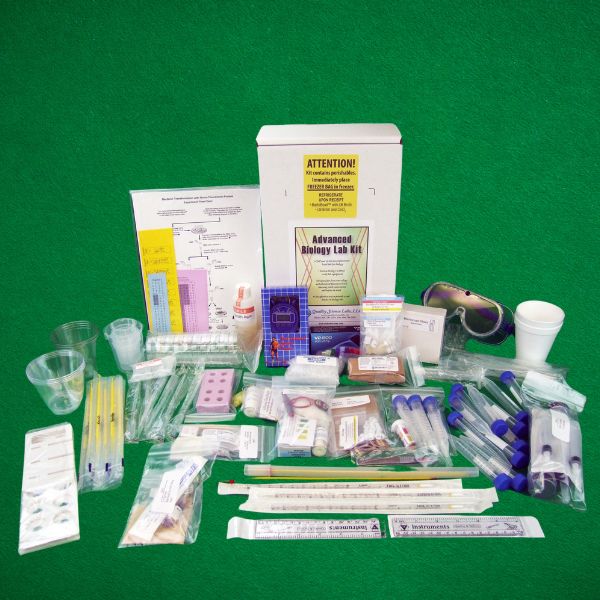
Advanced Biology Kit
- $323.75